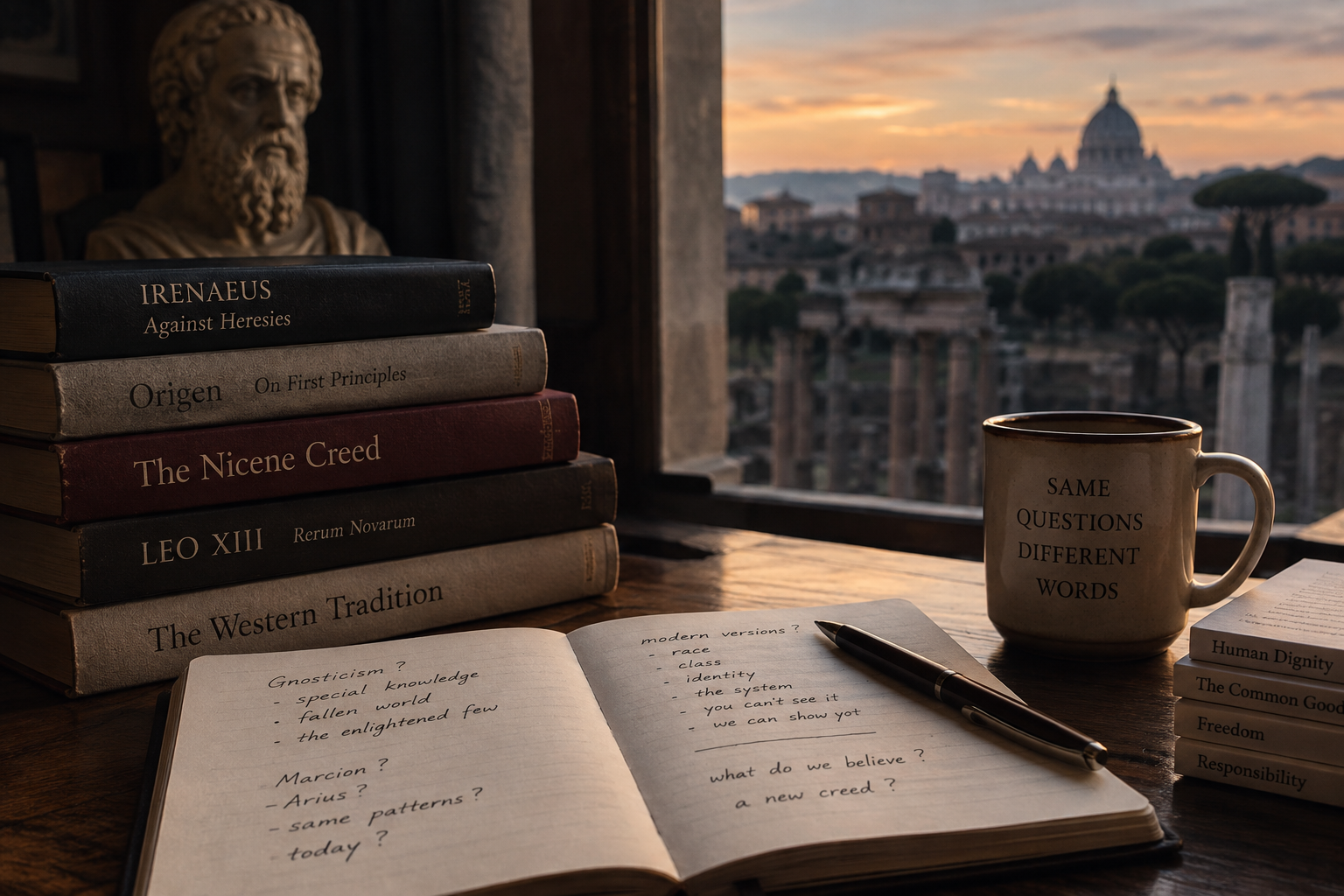
I have been reading a lot about the early Church lately. (been reading The Story of Christianity by Justo Gonzalez) Gnostics. Marcion. Arius. Irenaeus. The Nicene Creed. All these arguments that are almost 2,000 years old.
And I keep thinking: Are these arguments actually old? Or do we just keep having the same arguments over and over again and changing the words?
This all started because I was thinking about Gnosticism. Very simply (and I am probably butchering 2,000 years of theology here), the Gnostics had special knowledge. Gnosis. The world wasn’t what you thought it was. You THINK you understand the world. But you don’t. There is something underneath it. Something hidden. And once you have the knowledge, once someone teaches you how to SEE it, then you understand what is really going on.
Does this sound familiar? Because it sounds VERY familiar to me.
Think about some of the language around race.
You are racist.
No I’m not.
Well, you don’t understand your racism because you have been formed by a racist system.
Okay. But what if I disagree with that?
Your disagreement is evidence that you don’t understand the system.
Well….now what? How can I ever get outside of the argument?
The same thing happens with class.
You think capitalism is good because you have been formed by capitalism. You don’t understand your class interests. You need class consciousness. Someone has to show you the system underneath the system.
And who understands it?
The people with the special knowledge. The professor. The activist. The revolutionary. The vanguard. The person who has done the “work.”
Again. GNOSIS.
Now I am NOT saying Marx was secretly reading some Gnostic scroll and decided to recreate Gnosticism. That isn’t my point. My point is that maybe human beings keep falling into the same patterns of thought. Maybe these old theological fights were about something much bigger than theology.
They were arguments about truth. Who gets to know it? Is truth available to everyone? Can I use reason to get there? Can I disagree with you? Can your idea be proven wrong? Or do I need YOU to explain reality to me before I am even allowed to argue with you?
That’s what got me interested in Irenaeus. (one of the Early Church Fathers) His answer to the Gnostics was basically: No. There isn’t some secret Christianity behind Christianity. The faith is public. It was taught openly. The churches know it. The apostles taught it. You don’t need the secret decoder ring.
And that got me thinking about the Nicene Creed. Why did they need a creed? Because at some point you have to say: THESE are the things we agree on. Not everything. You can argue about a million other things. But here is the foundation.
And I wonder if the modern Western world needs something like that?
Not a Christian creed. We already have those. A secular creed. What are the basic things you have to believe for this whole liberal Western experiment to work? And by liberal I mean small “l” liberal. Free people. Free speech. Equal protection under the law. Individual rights. Private property. Democracy. Freedom of religion. The ability to argue with each other without deciding the other person is evil.
The basic Western project.
The worker matters. The family matters. Private property matters. The common good matters. Freedom matters. But freedom has to be FOR something.
And maybe most importantly: POLITICS CANNOT SAVE US.
This is where I think so many political ideologies go completely off the rails. They think if we can just fix the SYSTEM we can fix people. I don’t believe that. People are people. We are greedy. Generous. Loving. Selfish. Brave. Cowardly. Kind. Cruel.
No economic system is going to fix that. No revolution is going to fix that. No DEI training is going to fix that. No election is going to fix that.
You aren’t going to create heaven on earth.
So I tried to write down the basic things that I think hold a free society together. Not Republican. Not Democrat. Not even necessarily Catholic. Just the things underneath all of it.
Here is my first shot at it.
A Creed for a Free and Just Society
- We believe every person has equal dignity and is equal before the law.
- We believe people are individuals, not simply members of a race, class, sex, or political group.
- We believe in reason, conscience, freedom, and personal responsibility.
- We believe that truth belongs to no party, class, race, or group.
- We believe that disagreement is not guilt.
- We believe in freedom of speech, religion, association, and peaceful opposition.
- We believe in strong families, strong communities, and a government with limited power.
- We believe in private property, free enterprise, fair work, and a duty to the common good.
- We believe that rights come with duties to family, neighbor, community, and country.
- We believe tradition has wisdom, but injustice must be corrected.
- We believe no political system can perfect humanity.
- We believe our opponents are still our fellow citizens.
- We believe politics should serve the human person and the common good—not remake humanity or create heaven on earth.
I don’t know. Maybe I’m reaching. Maybe comparing modern political movements to 2,000-year-old theological fights is trying to make everything fit into my current obsession. But I keep coming back to it.
These arguments feel OLD.
The words have changed. God has been removed from some of them. Race or class or identity has been inserted. But the questions underneath them haven’t changed. Who are we? What is truth? Who gets to tell us what is true? Are we individuals with agency or products of systems? Can human beings perfect the world?
Those questions haven’t gone anywhere.
So maybe we should go back and read the people who already spent hundreds of years arguing about them.
Anyway. That’s my creed. What am I missing? What would you take out? What would you add?
And most importantly — do you believe it?
Leave a Reply